The Deepfake Candidate Who Almost Got Hired: What a Real Fraud Case Teaches IT Hiring Teams
The application was, by every account, beautiful. The CV was immaculate. The LinkedIn profile couldn't have looked better. The candidate had even emailed the CEO directly to say how excited he was about the role. Every signal pointed to the perfect hire.
He wasn't one. And what happened next is one of the most direct accounts we've seen of deepfake candidate fraud actually happening. Not a future hypothetical. A real attack, today, against an ordinary technical hiring process.
The story comes from a conversation on Matt Alder's Recruiting Future podcast with Samantha Swift, chief marketing officer at Cyberr (a cybersecurity and recruitment company, spelled with two r's to distinguish it from the generic word "cyber"). Cyberr had posted a job for a backend engineer, a role with broad access to its systems and data, and a candidate claiming to be a Romanian national moved quickly through the process.
The interview that didn't go as planned
Cyberr's chief product officer, Craig, joined the interview video call and, according to Swift, sensed almost immediately that something was off. He asked the normal questions, about past projects, about why the candidate wanted to join, and kept noticing small inconsistencies that, on their own, could each be explained away, but together formed a pattern.
The turning point was a coincidence nobody had planned for: Craig's wife is from Moldova, and Craig speaks Romanian. Since the candidate claimed to be Romanian, Craig suggested doing part of the interview in that language. The candidate stumbled, got confused. That's exactly the kind of failure a deepfake setup can't simulate on the fly, however well-prepared it is for predictable questions.
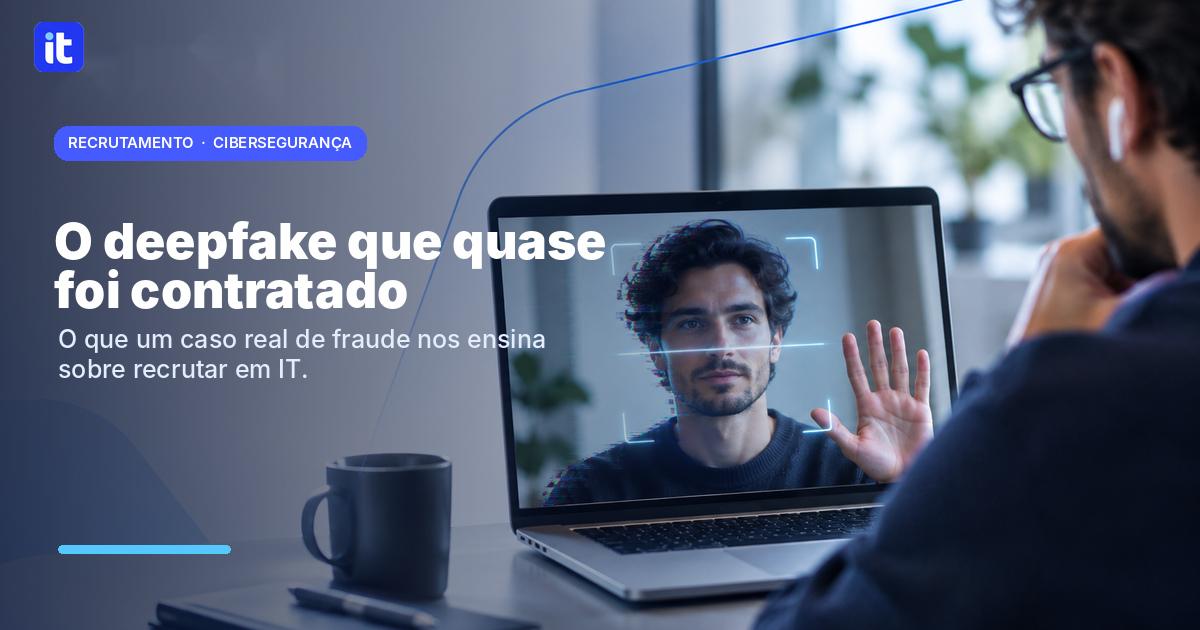
Craig then asked the candidate to turn off his virtual background, citing visual inconsistencies. And he ran the decisive test: he asked the candidate to raise his hand, then to pass his hand in front of his face. Deepfake technology still struggles with hands, one of the best-known weak points of these filters. The candidate refused the second request. The call ended there.
What the follow-up investigation found
With the candidate's details in hand, Cyberr's team started checking everything. The phone number he'd provided came from a service called sms24.me, which sells disposable virtual numbers, used, among other things, to appear to be in a country you're not actually in. The Irish university he claimed to have attended does have an international branch (common, notably, in China), but it doesn't offer the exact course he described, the way he described it.
Swift shared the case with Geoff White, an investigative journalist and co-host of The Lazarus Heist podcast, who has spent years researching North Korea-linked cyber fraud operations. White couldn't confirm the origin with absolute certainty, but recognized a CV format he'd seen repeatedly in fabricated applications tied to that country.
The risk starts long before the interview
One of the most important points in the conversation is that the video call itself is already late in the process. According to Swift, the risk starts with the job description itself. To attract technically qualified candidates, companies describe their tech stack and migration plans in detail, and that same information happens to be perfect for crafting a tailor-made fake CV. Red-teaming professionals use exactly these job descriptions to scope out where a company might be vulnerable. Even vendor case studies, however much marketing sense they make, publicly announce which tools a company has in place.
It's not just North Korea
The conversation makes clear that the motivations behind fraudulent applications vary considerably:
- People who land the job and then quietly subcontract the actual work to someone else, without the company's knowledge.
- Candidates who use deepfake tech purely to mask their real location, for example to appear to be based in the US in order to get paid US wages.
- State-linked operations, like North Korea's, which recruit and train people from a young age to work remotely for Western companies, often with the help of local accomplices who physically receive the company laptop and activate it in the "right" country.
- Security researchers like Jake Moore, who have publicly demonstrated (at an Infosecurity Europe event) getting "hired" via deepfake for real sales roles, purely to prove the technique works.
How to spot a deepfake in an interview
No single signal is conclusive proof, but together they tell a story:
- Video and audio slightly out of sync, or a facial filter that looks either too perfect or, conversely, a bit blurry at the edges.
- Odd or inconsistent backgrounds, and resistance to turning them off.
- Hesitations or "ums" and "errs" that sound slightly off. The technology still covers these small details worse than it covers speech itself.
- Answering a question with a question, buying time.
- Poorly rendered hands, and refusal to show them clearly on camera.
A genuine candidate does these things without any hesitation.
What hiring teams can do right now
The conversation leaves a set of concrete steps, not just generic warnings:
- Never jump straight to a voice-only call. Video from the very first conversation, always.
- Watch how much technical detail you put in job descriptions. Say enough to attract the right skills, without publishing a full map of your stack.
- Verify basic details before moving forward. A phone number from a virtual SMS service, or academic credentials that don't quite check out, are cheap to confirm and expensive to ignore.
- Have a second person on interviews, and compare notes across different interview stages. There are reported cases of someone only realizing a week after a candidate started that "this isn't the person I interviewed."
- Match the depth of verification to the role's level of access. Even a reception role has access to a lot of sensitive information simply by being present.
- Re-confirm identity at equipment handover, especially for remote roles.
- Monitor behavior after hiring. The security company KnowBe4 publicly and transparently disclosed hiring an alleged North Korean worker who was only caught once he started probing systems in ways inconsistent with his actual role.
Why this matters to us at Just IT
We built Just IT around a simple idea: whoever is applying to a job should know they're applying to a real company. That's why every company on the platform is verified by its Portuguese tax ID (NIF) before it can publish anything. This case shows the mirror image of the same problem: companies also need to know that whoever's on the other side of the interview is who they say they are. Trust in this market genuinely has to run both ways.
Based on the conversation between Matt Alder and Samantha Swift on episode 841 of the Recruiting Future podcast, "What Candidate Fraud Looks Like In Practice."